
This short article looks at ‘adjusting’ self-recording audiometry in order that it might be compared to manual audiometry such as pure tone audiometry.
This short article looks at ‘adjusting’ self-recording audiometry in order that it might be compared to manual audiometry such as pure tone audiometry.
There is much debate as to the utility of occupational hearing audiometry in NIHL cases. The value and reliability of the previous audiometry might depend on which side is making the argument. It might also depend on whether the audiometry supports later audiometry or not.
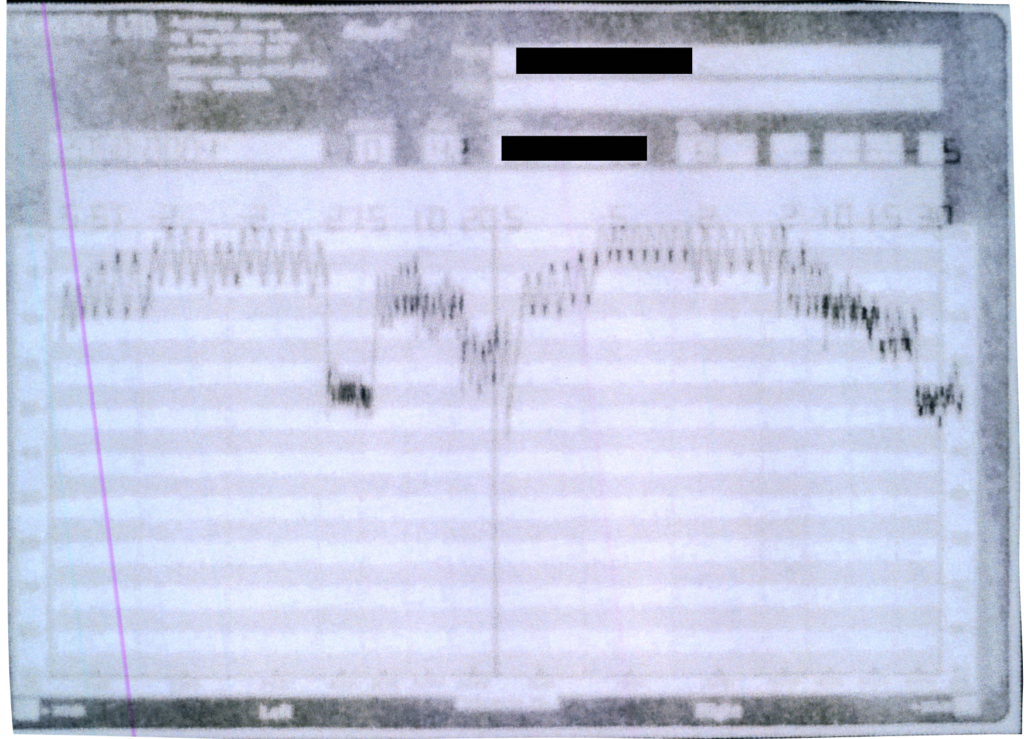
Békésy invented the first such audiometry equipment, and so the name is sometimes used to describe all such audiometry. However, other manufacturers later manufactured self-recording equipment.
Self-Recording Audiometry compared to Pure Tone Audiometry
Self-recording audiometry is where the frequency, the changes in hearing levels, and the recording are all done automatically. This can be done as a continuous sweep, such as Békésy's original equipment, or at fixed frequencies. For pure tone audiometry an audiologist manually changes the frequency and hearing levels, and manually records the results.
However, putting aside arguments as to the utility of such audiometry for another day, self-recording audiometry (as seen in the audiogram seen on this page) does not result in directly comparable readings to manual audiometry. Firstly, the recorded thresholds are found to be ‘better’ than pure tone audiometry. Secondly, self-recorded measurements are not in 5 dB steps as for pure tone audiometry.
Accordingly, BS 6655, as noted in ‘the Black Book’ (Guidelines for Medicolegal Practice, Assessment of Hearing Disability, King, Coles, Lutman & Robinson) gives a formula to adjust threshold readings from self-recording audiometry to manual/ pure tone audiometry.
The formula
The formula is straightforward and easy to adjust:
“Add 3 dB to the self-recorded measurement, then round to the nearest 5 dB”
Example
The example in the Black Book gives results for two tests:
| 1 kHz | 2 kHz | 3 kHz | |
| Self-recording measurement | 24 | 26 | 43 |
| Manual recording equivalent | 25 | 30 | 45 |
| 1 kHz | 2 kHz | 3 kHz | |
| Self-recording measurement | 22 | 24 | 51 |
| Manual recording equivalent | 25 | 25 | 55 |
For Practitioners:
Use of occupational health audiometry, especially self-recording audiometry, is often controversial in NIHL cases. Experts often disagree as to what degree such audiometry can be relied upon, if at all, and how accurate it is. However, if it is to be considered, then it is suggested that it should be ‘adjusted’ as set out in BS 6655 and 'the Black Book' before being compared to later manual/ pure tone audiometry.
More Articles
Jim Hester featured in Munkman - March 2025 Edition & Presenting APIL Webinars
Read on for details on how to access Jim's article and book a place to join his APIL webinars.
Asbestosis - assessing damages on a provisional basis
Hamilton v NG Bailey Limited [2020] EWHC 2910 (QB) provides a useful view of how a court might approach quantum in an asbestosis case when considering damages on a provisional basis rather than as a full and final settlement.
Pinnegar v Kellogg and ICI
This case is the latest in a series where the issue as to the reliability and credibility of historic witness evidence has been raised.
How to instruct Jim
Parklane Plowden Chambers
If you would like to instruct Jim to help you with your case, you can do so by getting in touch with Parklane Plowden Chambers.
Sign up to newsletter
Jim regularly writes articles of interest for personal injury and
occupational disease practitioners – sign up below:
Contact
Parklane Plowden Chambers
Portland House, New Bridge Street West, Newcastle-upon-Tyne, NE1 8AL
clerks@parklaneplowden.co.uk
0191 221 2121
parklaneplowden.co.uk